
Shrimad Bhagavad Gitaश्रीमद्भगवद्गीता
A conversation at the edge of a war.
Seven hundred verses, eighteen chapters, one question: how should a person act when duty is hard and the mind is full of doubt?
गीता को जानें। गीता को समझें। गीता को जिएँ।Know the Gita. Understand the Gita. Live the Gita.
The Shrimad Bhagavad Gita — the “Song of the Lord” — sits inside the Mahabharata, in the Bhishma Parva. Two armies stand ready at Kurukshetra. Arjuna, the greatest archer of his age, asks his charioteer to drive between them, sees his teachers and kinsmen on the other side, and cannot go on. He puts down his bow.
His charioteer is Bhagwan Shri Krishna. What follows is not a speech about war but a teaching about how to live: on what we are beneath the body and the mind; on duty and how to perform it without being bound by it; on the steadiness that no success or failure can shake; on devotion that any heart may offer; and on the freedom that comes of surrender.
By the end Arjuna says his delusion is gone and his doubt resolved — and he takes up his bow again. He is not given a different battlefield. He is given a different understanding of the one he is standing on.
The transformative methodगीता की परिवर्तन-पद्धति
From Arjuna’s confusion to responsible action.
The Gita begins not with certainty, but with a capable human being overwhelmed by moral conflict. Arjuna’s honesty opens the way to instruction.
विषाद → ज्ञान → विवेक → धर्म → कर्म → भक्ति → समर्पण
अर्जुन से हम तक। गीता की यात्रा विषाद से विवेक और संशय से धर्मसम्मत कर्म तक की यात्रा है। यही परिवर्तन HGB के कार्य का केंद्र है।
कार्पण्यदोषोपहतस्वभावः… धर्मसम्मूढचेताः।
शिष्यस्तेऽहं शाधि मां त्वां प्रपन्नम्॥
Arjuna acknowledges that his understanding of Dharma is confused and asks Shri Krishna for decisive guidance.
Bhagavad Gita 2.7नष्टो मोहः स्मृतिर्लब्धा त्वत्प्रसादान्मयाच्युत।
स्थितोऽस्मि गतसन्देहः करिष्ये वचनं तव॥
He emerges with understanding restored, doubt resolved and the readiness to act. This is the Gita’s transformative arc.
Bhagavad Gita 18.73Between these two verses lies the work of the Gita: confusion is met with wisdom; wisdom matures into discernment; discernment clarifies Dharma; and Dharma becomes action.
How we teach it
Not slogans, and not knowledge removed from life.
To make the Gita understandable, practicable and transformative — so that knowledge becomes discernment, devotion shapes character and personal growth becomes service.
So the teachings on this website are arranged as nine themes, each anchored in the verses themselves — Sanskrit, transliteration, plain meaning, and what it asks of an ordinary day. Read the chapters for the whole; read the themes for the practice.
Where to go next
Three ways into the text.
The eighteen chapters
Every chapter, its Sanskrit name, its length and what it covers — with a reading order for beginners.
Read the chaptersNine themes, with shlokas
9 themes — Karma Yoga, steadiness, svadharma, bhakti and more — each with five verses in Sanskrit, Hindi and English.
Gita’s learningsGita path at the Bhawan
The Gita was spoken before it was written. Satsang, path and discourse are held on the premises, and all are welcome.
Plan a visitCommon questions
About the Gita.
What is the Shrimad Bhagavad Gita?
A dialogue of 700 Sanskrit verses in 18 chapters, found in the Bhishma Parva of the Mahabharata. On the battlefield of Kurukshetra, Arjuna is overcome by doubt and grief; his charioteer, Bhagwan Shri Krishna, teaches him about the Self, duty, selfless action, devotion and liberation.
Who spoke the Bhagavad Gita, and to whom?
Bhagwan Shri Krishna spoke it to Arjuna, the third of the Pandava brothers, just as the armies of the Mahabharata war were drawn up at Kurukshetra. Sanjaya recounts the dialogue to the blind king Dhritarashtra, which is how it reaches us.
Is the Gita only for Hindus, or only for renunciates?
The Gita is addressed to a householder who has work in front of him and cannot walk away from it. It has been read for more than two thousand years by farmers and kings, students and soldiers. Anyone who must act in the world can read it.
Why is the Trust named after the Gita?
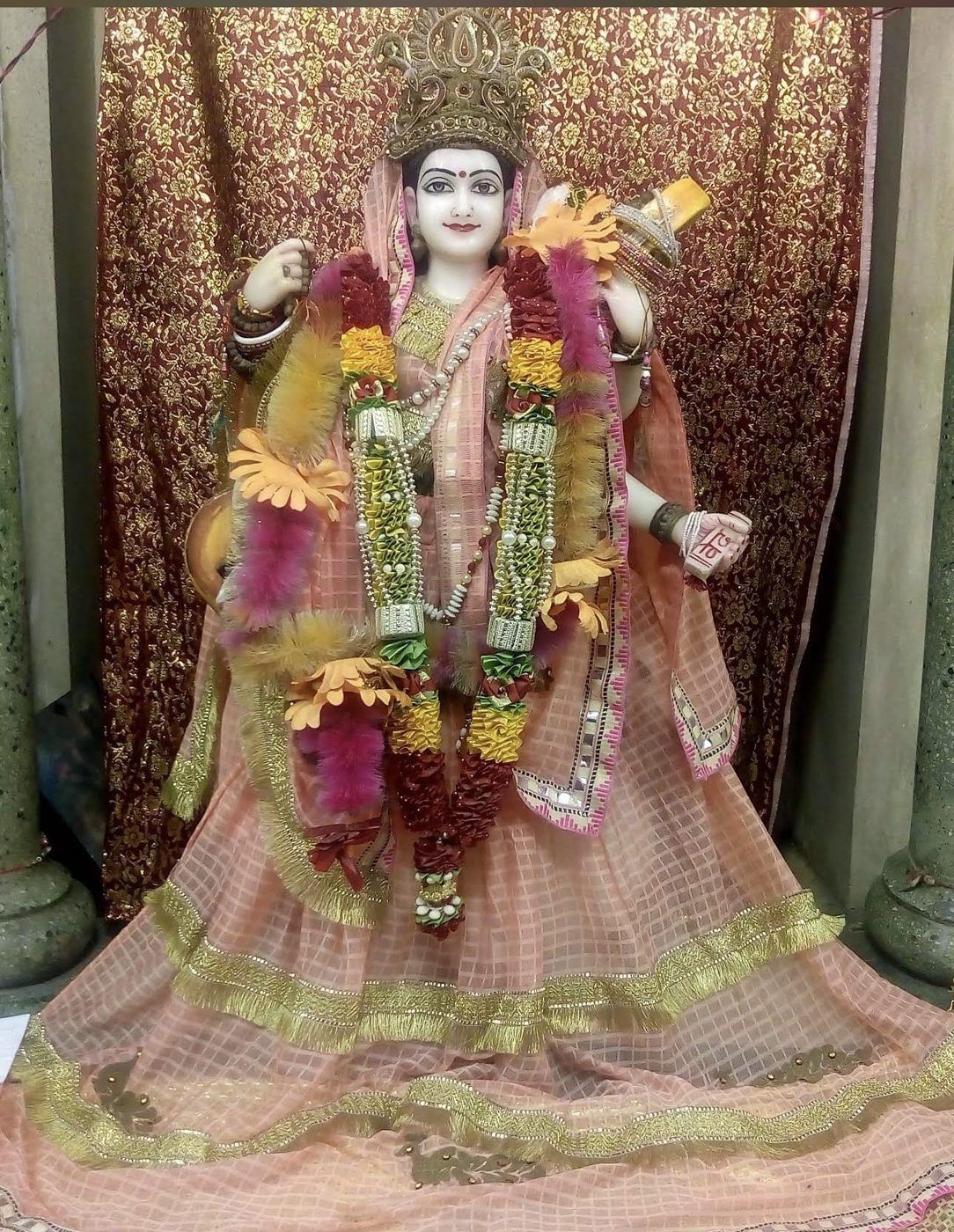
The founders built a Gita Bhawan on this land before the Trust was registered on 3 October 1968. The recitation of the Gita is one of the five objects in the Trust Deed, and the temple houses Shri Krishna, the Gita’s speaker, with Maa Saraswati, the goddess of learning.